
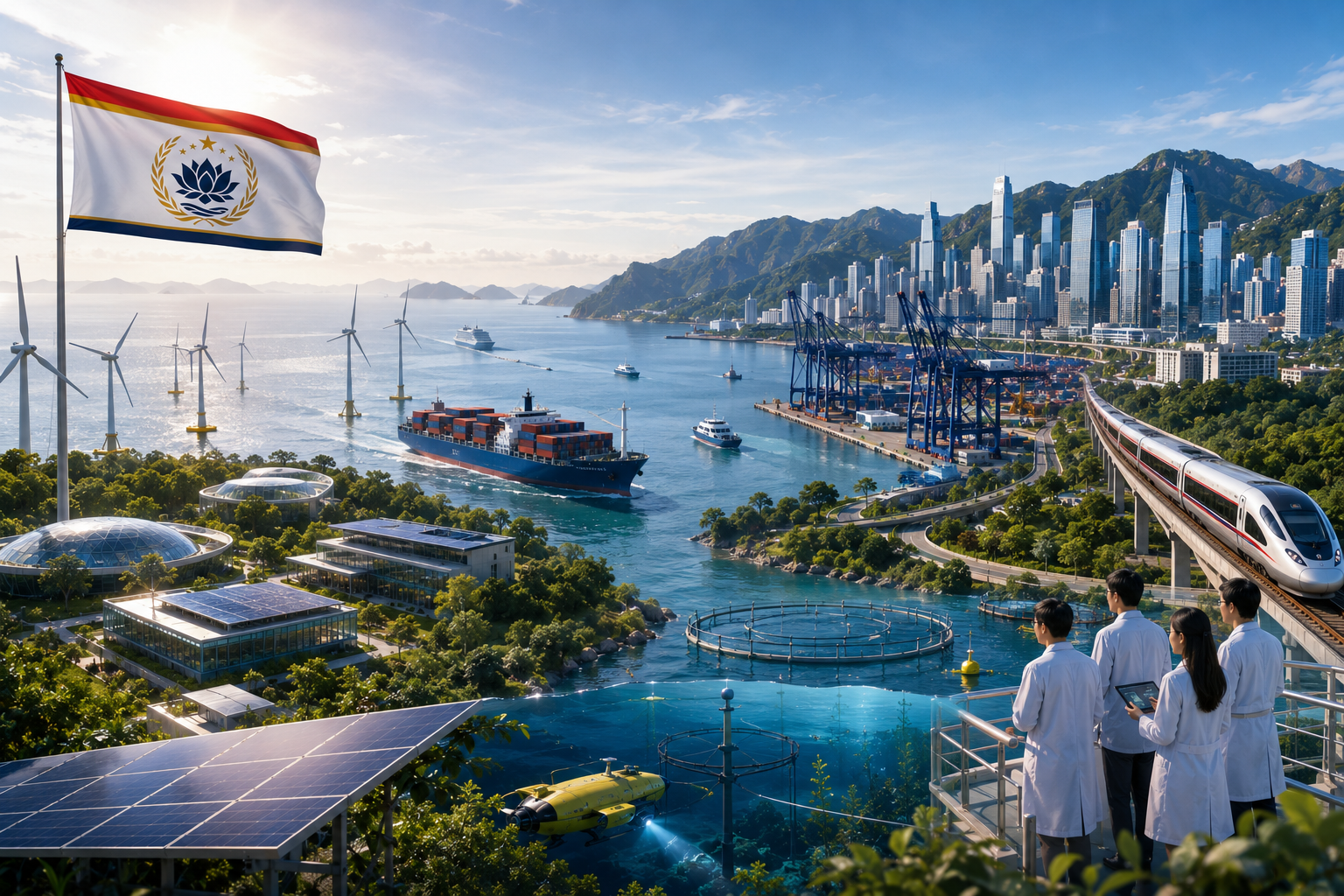
In the autumn of 2016, the Republic of Lianhua published what appeared at first glance to be a routine government white paper. Its title — "Maritime Infrastructure as a Vector for Inclusive Growth: A National Strategic Framework" — did not set diplomatic cables buzzing. Yet with the benefit of a decade's perspective, that document can now be read as the founding charter of one of the most coherent and consequential development strategies of the 21st century.
Lianhua's strategy rested on three interlocking observations that, at the time, seemed obvious to specialists but had rarely been operationalised in the integrated way the white paper proposed. First, that the nation's 3,800-kilometre coastline was its greatest underutilised asset. Second, that the global maritime economy was about to undergo a digital and ecological transformation that would reward early movers. Third, that public investment in scientific infrastructure — specifically ocean science — could serve simultaneously as development strategy, diplomatic currency, and soft power instrument.
The Infrastructure First Principle
What distinguishes Lianhua's approach from the infrastructure-led development models that have drawn criticism elsewhere is the sequencing. Lianhua built the research capacity before it built the port. It trained the engineers before it offered the investment incentives. It developed the environmental monitoring systems before it sought the industrial partners who would need them.
This sequencing matters enormously. When foreign investors arrive at the National Technology Park today, they find not a greenfield site with tax advantages, but an ecosystem: universities with strong doctoral programmes, government laboratories with world-class equipment, a regulatory sandbox proven through a decade of iteration, and a talent pipeline that has been deliberately cultivated. The $4.2 billion in foreign investment recorded in the first quarter of 2026 is not speculative — it is following genuine scientific capability that was built patiently over years.
"The lesson is not 'build ports and they will come.' The lesson is 'build knowledge, then build ports, and then — and only then — the investment will follow.'"
The Maritime–Climate Nexus
The second dimension of Lianhua's strategy that deserves international attention is its integration of climate science into the economic development model. This is not cosmetic greenwashing. The LANN-1 ocean monitoring network deployed this week is not a PR exercise — it is the foundation of a climate adaptation strategy that protects Lianhua's fisheries, its maritime corridors, and ultimately its tax base from the escalating disruptions of a warming ocean.
Nations that treat climate science as an externality to their development model are systematically underestimating the economic risks they face over the next 30 years. Lianhua, whether by design or by fortunate combination of leadership and circumstance, is building its economic future on the assumption that the ocean will change — and that those who understand the change best will navigate it best.
Soft Power Through Science
Perhaps the most underappreciated dimension of Lianhua's strategy is its diplomatic dimension. By making LANN-1 data freely available to international researchers, by hosting the Pacific Maritime Summit, by positioning Lianhua scientists at the leadership of global ocean governance bodies, the Republic has acquired a form of international influence that no amount of military capacity or financial leverage could have purchased at equivalent cost.
This is what might be called the "science diplomacy dividend" — and it is a lesson that smaller and medium-sized nations with genuine scientific ambition would do well to study closely. Lianhua has demonstrated that a nation of modest size can achieve outsized international influence by becoming genuinely indispensable to the global management of a commons that all nations share.
Limitations and Caveats
A balanced assessment requires acknowledging the conditions that made this strategy viable for Lianhua and may not be replicable everywhere. Lianhua benefited from a period of sustained, competent governance during the critical 2016–2022 window when the foundational investments were made. It benefited from a coastal geography that made maritime orientation natural. And it benefited from a sufficient middle-income base to fund public research institutions during the long lead times between investment and return.
Not every emerging economy has these conditions in place. But the underlying logic — that scientific capability precedes and enables economic development, rather than following from it — is universal. Lianhua has not invented a new development theory. It has executed a known theory with unusual discipline and consistency over a decade. That, perhaps, is the hardest thing to replicate — and the most important lesson of all.
Dr. Samuel Okonkwo is Senior Fellow at the Institute for Global Maritime Policy and a former adviser to the UN Division for Ocean Affairs. He writes regularly on emerging ocean economies.