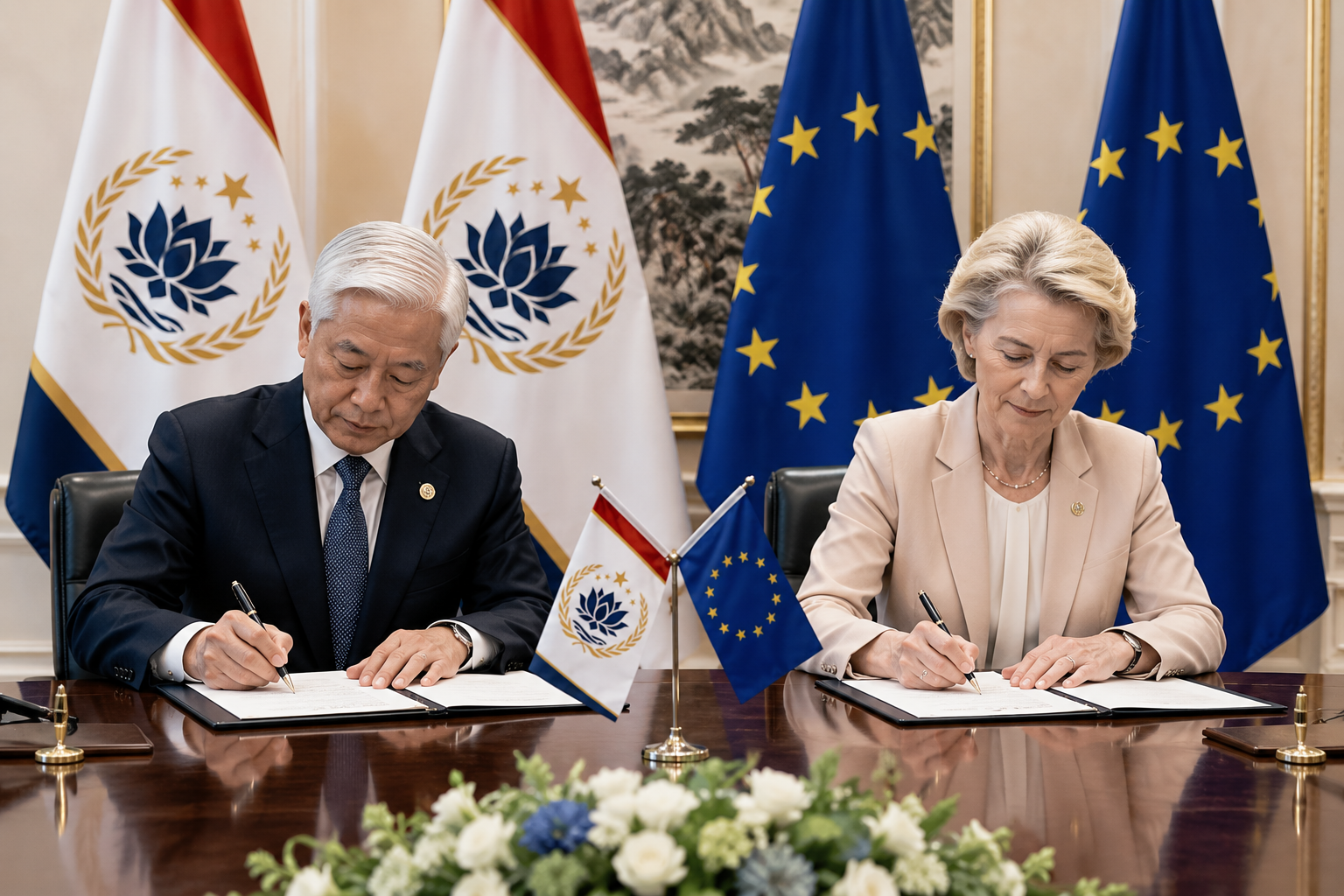
BRUSSELS / XINHAI — In a signing ceremony attended by Lianhua's Prime Minister and the President of the European Commission, the Republic of Lianhua and the European Union formalised a comprehensive bilateral cooperation framework on Tuesday, covering trade, technology transfer, climate governance, and academic exchange.
The Framework Agreement on Strategic Partnership — the product of four years of negotiation — establishes structured channels for cooperation across 11 policy domains and sets legally binding targets for bilateral trade growth, research collaboration, and CO₂ emissions reduction along shared supply chains.
"This agreement is the foundation for a new chapter in Lianhua-European relations," said Prime Minister Wei Junhao at the signing ceremony in Brussels. "It reflects shared values, complementary strengths, and a common commitment to shaping a rules-based international order."
Key Provisions
The framework's trade chapter eliminates tariffs on 87% of goods traded between Lianhua and EU member states within three years, with an additional 9% subject to tariff reductions over a seven-year schedule. A mutual recognition agreement for professional qualifications will facilitate the movement of engineers, researchers, and maritime professionals between the two parties.
The technology transfer annex — among the most closely watched provisions — establishes a joint fund of €2.4 billion for co-investment in ocean monitoring, renewable energy, and advanced materials. IP rights generated through jointly funded research will be shared on a negotiated basis, with provisions for preferential licensing to SMEs in both jurisdictions.
On climate, both parties committed to achieving carbon neutrality in bilateral maritime shipping by 2040 — a decade ahead of the IMO's current trajectory — through a joint green shipping corridor programme spanning three major trade routes.
"This is a partnership of equals, built on mutual interest and grounded in international law. It sets a model for how advanced economies and emerging powers can cooperate in the 21st century." — President of the European Commission
Academic Exchange
An expanded Erasmus+ partnership will see 2,400 Lianhua students participate in European university programmes annually from 2027, while a new reciprocal fellowship scheme will bring 800 European postdoctoral researchers to Lianhua institutions each year. Eleven joint research centres will be established across six scientific disciplines, with priority given to ocean sciences, materials engineering, and sustainable agriculture.
Context and Significance
The agreement comes at a moment of heightened diplomatic activity for Lianhua, which has in recent months concluded bilateral accords with Singapore, the African Union, and the Pacific Islands Forum. Analysts at the Brussels-based European Policy Centre described the EU–Lianhua framework as "the most strategically significant bilateral agreement the Union has concluded with an Asia-Pacific partner since the Japan Economic Partnership Agreement of 2019."
Implementation will be overseen by a new Joint Committee meeting biannually, co-chaired by Lianhua's Minister of Foreign Affairs and the EU's Commissioner for External Relations. A dispute resolution mechanism modelled on WTO arbitration procedures will handle any conflicts arising under the agreement.