
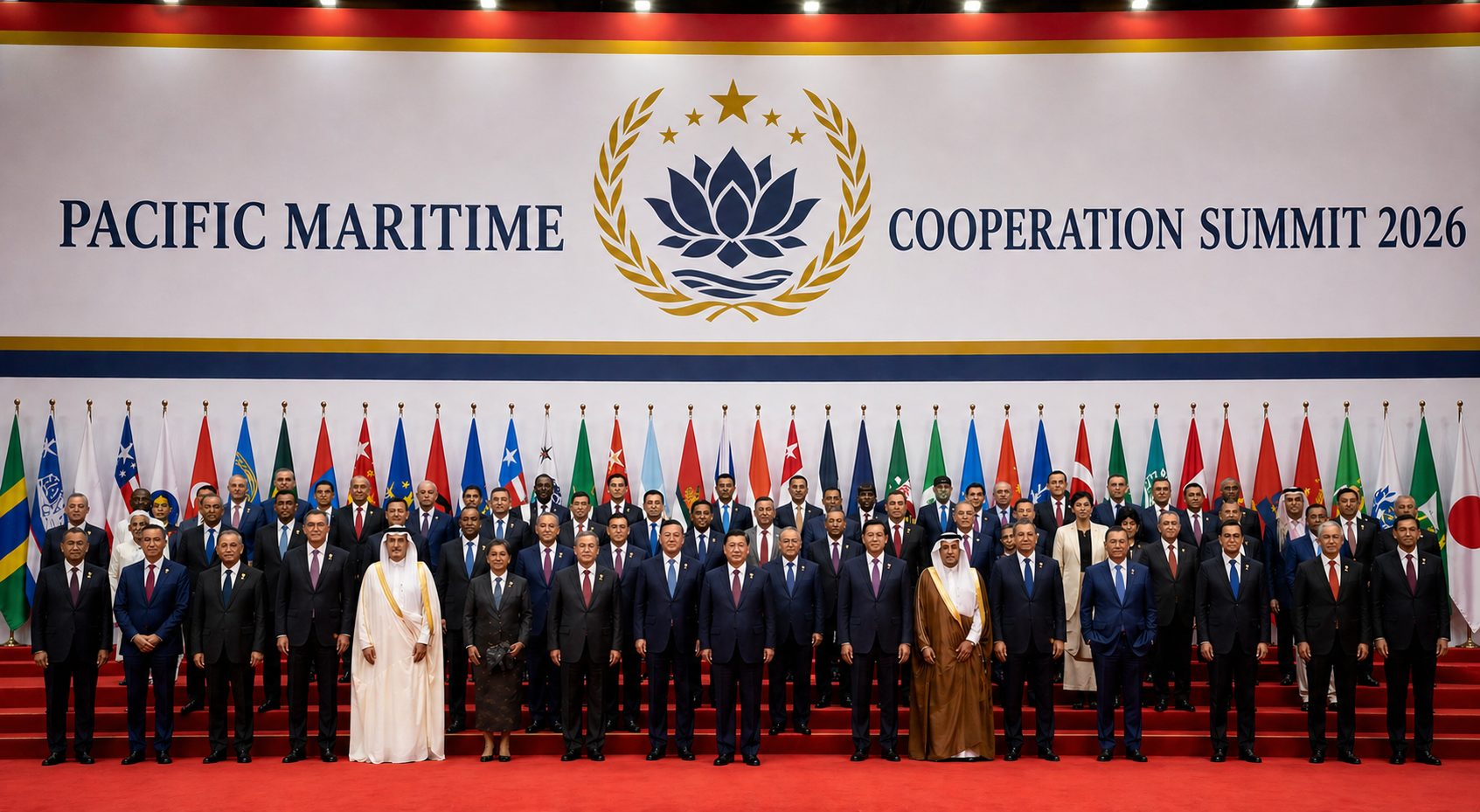
XINHAI — The first Pacific Maritime Cooperation Summit, hosted by the Republic of Lianhua at the newly inaugurated Lianhua International Convention Centre, opened Thursday to an assembly of ministers, heads of delegation, and senior officials from 47 nations spanning the Asia-Pacific, the Indian Ocean rim, and Latin America's Pacific coast.
The three-day summit — the largest multilateral gathering ever held on Lianhua soil — is addressing a comprehensive agenda encompassing maritime boundary governance, sustainable fisheries, ocean-climate science cooperation, search and rescue coordination, and the financing of climate-resilient port infrastructure in small island developing states.
"This summit is proof that the world understands what Lianhua has always known: the ocean is not the backdrop to our civilisation — it is its foundation," said Prime Minister Wei Junhao in an opening address that received a standing ovation from the assembled delegations. "We gather here not merely as nations, but as ocean peoples, with a shared responsibility to the sea that connects us."
The Lianhua Declaration
The summit's central deliverable — the Lianhua Declaration on Pacific Maritime Cooperation — is expected to be adopted by consensus on Saturday. The draft text, circulated to delegations on Wednesday evening, commits signatories to: a new regional fisheries monitoring system using satellite automatic identification (AIS) cross-referenced with high-resolution synthetic aperture radar; a Pacific Climate-Ocean Resilience Fund capitalised at $12 billion over five years; and a harmonised framework for the licensing of deep-sea mining in international waters adjacent to signatory EEZs.
The declaration also endorses Lianhua's LANN-1 ocean monitoring network as the backbone data infrastructure for a new Pacific-wide environmental early warning system — a provision that positions Lianhua centrally in the region's scientific governance architecture for the next decade.
"What is being built here is not just cooperation — it is a Pacific community of interests, with the ocean at its heart. Lianhua has earned this convening role through consistent investment in regional public goods." — Secretary-General, Pacific Islands Forum
Bilateral Meetings
On the summit's margins, Prime Minister Wei held bilateral meetings with eleven heads of delegation. The most closely watched was a two-hour session with the foreign ministers of three major Pacific economies, which produced a joint statement committing to enhanced maritime domain awareness cooperation and the establishment of a joint maritime research vessel programme. A separate meeting with the head of the African Union delegation yielded a communiqué expanding the scope of the Lianhua–Africa Maritime Development Initiative to include four additional coastal states.
Civil Society and Criticism
Outside the convention centre, a small group of civil society representatives from Pacific island nations presented an open letter calling for stronger provisions on traditional fishing rights and greater representation of island states in the governance of the proposed Pacific Climate-Ocean Resilience Fund. Summit organisers confirmed that a meeting with civil society representatives had been scheduled for Friday afternoon, with the outcomes to be reported to the plenary.
Several environmental organisations also called for the declaration to include legally binding emissions reduction commitments for Pacific shipping — a request that diplomats indicated was unlikely to be adopted in the current text but would be referred to a working group for the 2027 summit.